

Ever bailed on a social commitment — work, volunteer, or personal — because it felt inconvenient?Ìý
Master of Social Work student Mia Macknezie argues that following through, even when you don’t feel like it, can help push back against political polarization and other forces fracturing community today.
“Just show up. There’s obviously benefits for yourself, but there’s also this contribution to helping build ethical, healthy communities that we know provide so many protective factors and positive outcomes,� says Mia.
Just show up.
This argument recently earned her first prize and $7,000 in the Dal-wide Irving and Jeanne Glovin Award essay competition for her paper, It Takes a Village: Community and Good Human Conduct. The annual competition, open to all students at Dal, was established in 2003 by the Oskar Schindler Humanities Foundation to foster research into the meaning and underlying principles for “good human conduct.�
“For me, this makes a huge difference in my being able to continue to engage with and focus on the second year of my degree,â€� says Mia, who is looking to build a social work practice following her degree.Ìý
Community shapes conduct
Mia’s essay centres around the idea that participation in community — from less formal family and social groups to more structured settings such as schools and public programs and services — can help shape people’s behaviour and reinforce ethical conduct.Ìý
You can read Mia's full essayÌý.
While she says her choice of essay topic followed naturally from her undergrad thesis on mitigating the negative impacts of loneliness, it also emerged from a more personal place. When she moved to Halifax last August, she didn’t really know anyone.Ìý
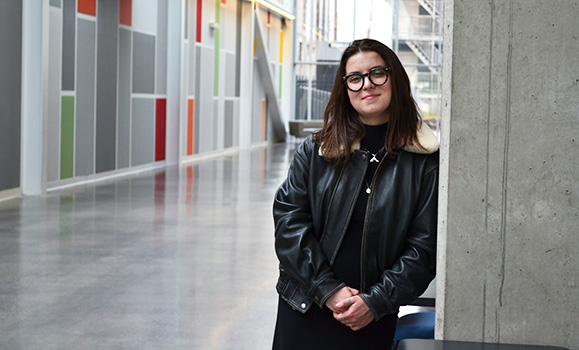
“Join the run club, show up to social events, even when maybe you don't know a lot of people there,� she says, recalling her own attitude. “It's saying yes to things in service of connecting with people.�
Mia also felt inspired by the lessons of her late grandfather, to whom she was close.Ìý
"This was one of the things that he spoke about a lot, that commitment to family and community," she says.
When community frays
Mia cites the COVID-19 pandemic as a period in which people seemed to embrace small acts of community, whether it was dropping off groceries to neighbours or loved ones or stopping outside someone’s residence to chat.Ìý
She says that feeling has begun to slip away in recent years as powerful social forces erode this kind of nurturing community. She discusses how misinformation and disinformation, hate speech, and other trends are increasing mistrust between people and polarizing politics.Ìý
What can be shared across cultures is not a single moral code, but the expectation that communities hold themselves accountable for how they treat their members.
While definitions of ‘good’ community vary across cultures and families, her argument centres around a vision rooted in dense relationships, mutual care and respect, and shared responsibility across generations.
“Good human conduct is not a fixed list of rules but a commitment to treat others with dignity, to refuse gratuitous harm, and to repair relationships when harm occurs,â€� she writes in her essay. “What can be shared across cultures is not a single moral code, but the expectation that communities hold themselves accountable for how they treat their members.â€�Ìý
Learn more: See the full list of this year's essay award recipients